日本語 DEOXYGENATION TECHNOLOGY Deoxygenation Process®
Formulate the actives others can't keep stable WHAT YOU CAN FORMULATE
PRIMALL's patented Deoxygenation Process® (Japan Patent No. 7398164) removes oxygen across the entire process — so notoriously unstable actives stay potent and stable from production all the way to your customer.
We cut off oxygen
from the very first step of production. That is the "Deoxygenation Process®."
By keeping oxygen away from the first step to the last,
we protect the ingredients you want to deliver in their "freshly made, full-strength" state.
Patented Technology / Japan Patent No. 7398164
The mechanism is simple: seal out oxygen at every step.
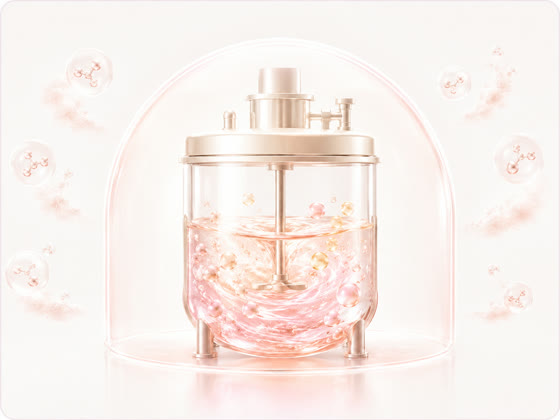 STEP 01
MAKE
Production runs in an oxygen-purged environment from the blending stage onward.
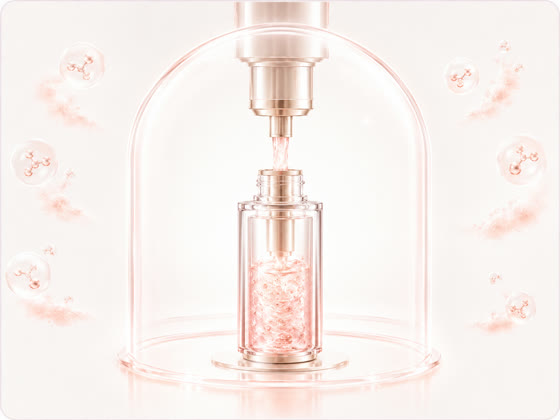 STEP 02
FILL
Containers are filled and sealed so that oxygen cannot get in.
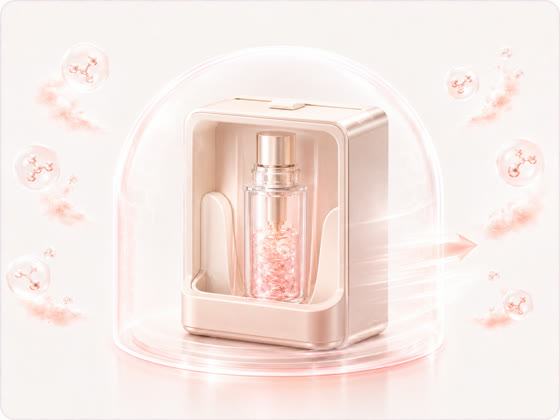 STEP 03
DELIVER
The product stays protected from oxygen all the way to the customer.
That is how we preserve just-made freshness,
delivering the "ingredient power that used to be lost to oxidation" straight to the skin.
A manufacturing partner ready for your brand FROM PROTOTYPE TO DELIVERY
The credentials and flexibility overseas brand owners ask about first — quality, minimum order, lead time and regulatory fit.
See the difference oxidation makes SEE THE DIFFERENCE
Why does oxygen break down ingredients, and how does the Deoxygenation Process change that? See it in both the mechanism and the real-world result.
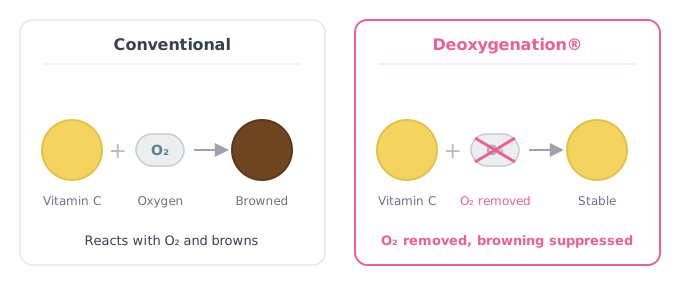
▲ How oxygen discolors ascorbic acid (vitamin C) — conceptual diagram
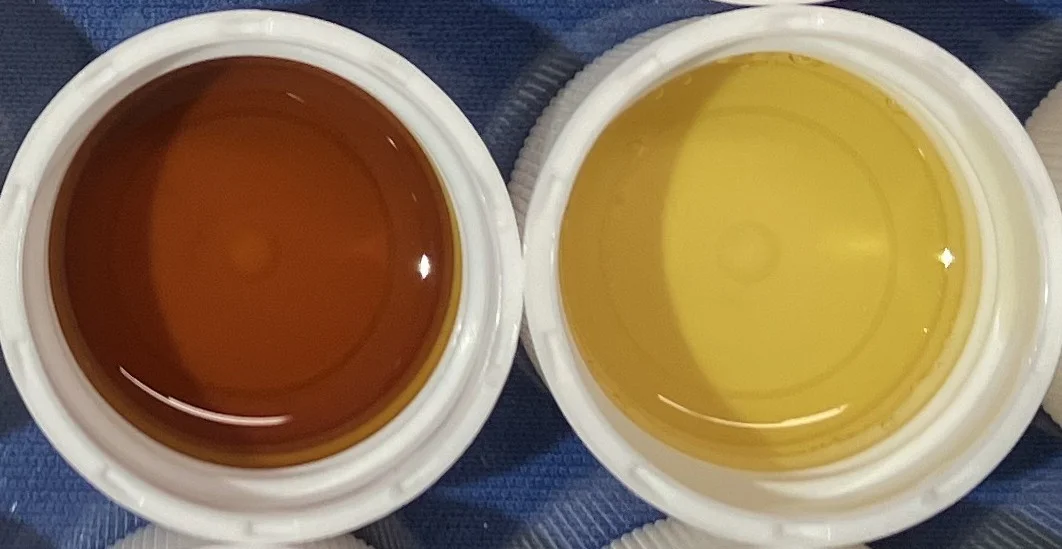
▲ Actual comparison. Left: conventional process (browned) / Right: Deoxygenation Process® (discoloration greatly suppressed)
Fragrance, kept just-made fresh KEEP THE SCENT FRESH
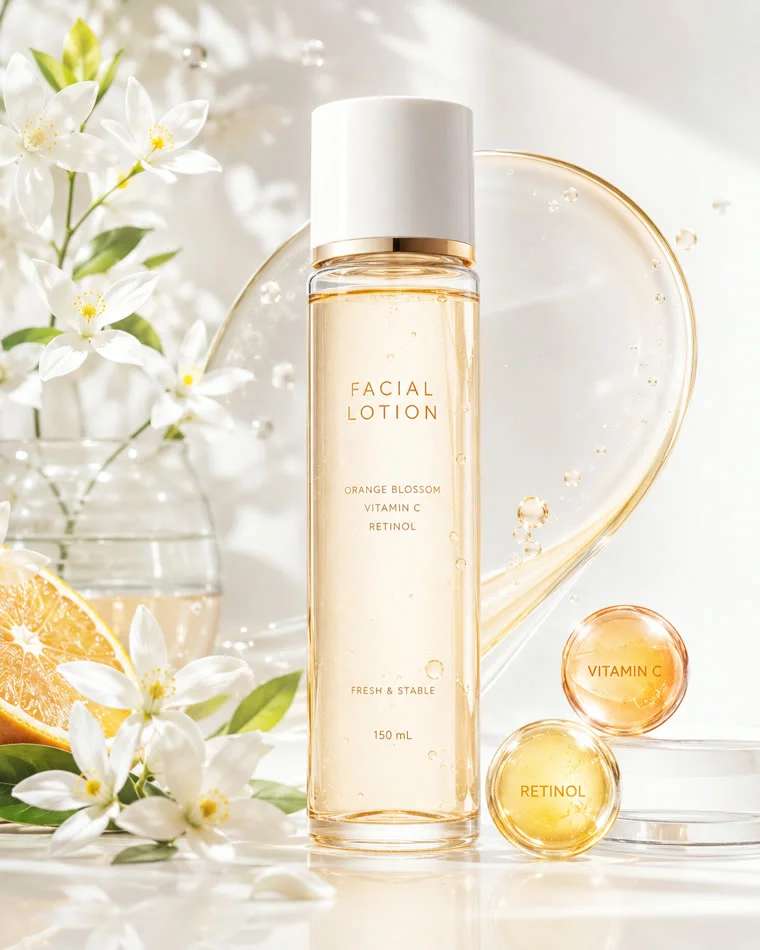
*Image for illustration only
Natural fragrances are delicate and degrade easily when exposed to oxygen. The Deoxygenation Process® suppresses scent oxidation too, delivering that "just-made aroma" the moment the product is opened.
As a real example, we developed a freshness serum that locks in the natural scent of orange blossom (the second commercialized product from the Expo 2025 Osaka "Reborn Challenge"). The more a formula relies on its fragrance, the more the Deoxygenation Process® proves its worth.
Stability data by ingredient INGREDIENT PERFORMANCE
The Deoxygenation Process makes formulations that were once difficult finally possible.
Tap or click an ingredient to open its detailed stability data.
Ascorbic acid (vitamin C)
A flagship brightening / antioxidant active
Prevents oxidative breakdown so vitamin C's true performance reaches the skin. One of the most sought-after actives for texture, firmness and clarity care — its weakness has always been how easily it degrades.
Vitamin C is in high demand as a brightening active, yet it degrades quickly through oxidation — the familiar problem that "the effect doesn't last." With the Deoxygenation Process it achieves over 90% retention in a long-term stability test at 40°C for 6 months (an estimated equivalent of roughly 3 years at room temperature), compared with 10% or less for the conventional method.
(*Measured by HPLC. Room-temperature equivalence is an accelerated-aging estimate.)
Ascorbic acid retention (40°C, 6 months / estimated equivalent of ~3 years at room temperature)
WHAT BECOMES POSSIBLE
- Quasi-drug formulations using ascorbic acid as an active (lotions and serums; fragrance changes supported)
- High-retention ODM/OEM formulations that let you claim "vitamin C that works"
Ascorbic acid × retinol, together
A formulation that defies industry convention
Prevents the mutual oxidation that cancels them out — pairing two powerhouse actives in one bottle. Vitamin C (clarity) and retinol (firmness / aging care): two leading actives that previously could not coexist, now combined.
Ascorbic acid is stable at pH 3–3.5, while retinol is stable at pH 5–6. Because of these conflicting requirements, combining the two has long been considered "difficult by industry consensus."
The Deoxygenation Process makes it possible to bring ascorbic acid closer to retinol's stable pH, enabling a single product that replaces a once-complicated routine.
WHAT BECOMES POSSIBLE
- ODM of high-performance all-in-one serums with vitamin C + retinol
- Proposals for "complete-in-one-bottle" aging-care formulations
Glutathione
A brightening active prone to oxidative breakdown
Prevents the loss of reducing power from oxidation, keeping it in a fresh state. An active drawing attention for clarity care — very delicate and prone to breaking down, which made it hard to formulate.
Glutathione breaks down easily with oxygen, making stable formulation difficult. The Deoxygenation Process greatly reduces the loss of its reducing power, allowing delivery to customers in a fresh state. (*Measured by redox titration.)
WHAT BECOMES POSSIBLE
- Stable ODM/OEM of high-concentration glutathione formulations
- Product design that lets you claim "freshly made, full-potency glutathione"
Hydroquinone
Solving discoloration and quality-loss problems
Prevents oxidative discoloration, keeping a bright, clear quality for the long term. A care ingredient for a brighter impression — brown discoloration had been the cause of lost product trust.
Hydroquinone had the problem of turning brown within about a month due to oxidation, and visible discoloration translates directly into lost consumer trust. The Deoxygenation Process achieves discoloration control equivalent to 2–3 years.
Hydroquinone discoloration-control period
WHAT BECOMES POSSIBLE
- ODM of long-stable hydroquinone formulations that resist discoloration
- Formulation design that accounts for shelf display and inventory periods
Whether hydroquinone can be used — and at what level — depends on the destination market. In the EU it is prohibited in cosmetics (Regulation 1223/2009, Annex II; only an artificial-nail exception applies), and in the US it cannot be sold as an OTC skin-lightening product without FDA new-drug approval. Permitted uses vary by country.
We help you choose the right active and design a formulation that is compliant for your target markets — so regulatory fit is considered from the very first proposal.
DeoxyMark® CONSUMER-FACING TRADEMARK

Products made with the Deoxygenation Process can carry the registered "DeoxyMark®." It is a way to communicate "an oxidation-protected formulation" directly to consumers.
We also handle OEM projects that switch existing formulations to the Deoxygenation Process. Brands that already have a formulation in hand are welcome to reach out.
Frequently asked questions FREQUENTLY ASKED QUESTIONS
Q.What is the Deoxygenation Process?
Q.How stable is ascorbic acid (vitamin C)?
Q.Can retinol and vitamin C be formulated together?
Q.Why does vitamin C discolor when it oxidizes?
Q.Can hydroquinone discoloration also be suppressed?
Q.Do you handle OEM projects with the Deoxygenation Process?
About Deoxygenation Process® formulations & OEM projects
For formulation proposals, detailed stability data, and the product categories we can support,
please reach out through our contact form.